

This isn't really about Montessori, but it somehow fits so I decided to make a post about it.
I just started watching Jamie Oliver's Food Revolution and, wow, is that some powerful stuff! For those that don't know, Jamie Oliver is a British chef who's taking on the American obesity epidemic by introducing whole foods to schools. He implemented a similar program in south London with great success. The idea is getting a bad rap in the States, which is really awful if you ask me. How is it controversial to feed kids nutritious food? Isn't that what we all strive for?
There was one part of the episode last week that really struck me as a Montessori mom. Jamie asked for knives and forks to be set out for the kids to use and it caused quite a stir. The lunch staff was appalled that anyone would let preschoolers and kindergartners use knives and forks because they are too young to know how to use them. Jamie's response? "This is school. You teach them to spell, you teach them to read, you teach them to write... you teach them how to use a knife and fork."
How easy it is to forget there are some things children need to learn that are more important, more basic, than what is in a standard school curriculum.
The clip below is very poor quality, but the only clip I could find! If you want to check out the whole episode, you can watch the series on Hulu.
Showing posts with label Practical Life. Show all posts
Showing posts with label Practical Life. Show all posts
Wednesday, March 31, 2010


Friday, March 26, 2010
Spring cleaning with a toddler
Oh, yes, it can be done.
Now, no two-year-old I know is going to organize your sock drawer (in any way you might call organized) or alphabetize your CDs, but that down and dirty deep clean you've been putting off all winter? Little kids have you covered.
Last week (yes, last week, it takes me awhile to formulate posts) we spring cleaned our bathroom. I had been meaning to do it for a few days, putting it off because I thought Ryann would need to be asleep or at her dad's before I could do any "serious" cleaning. I had already cleaned out the bathroom cabinets a week earlier, a little at a time, but how would I clean the tub and mop the floor with a "helper?" I had previously tried to scrub the kitchen floor with her help. I tried to have her watch how I did it: Dip a sponge in soapy water (Dr. Bronner's soap and baking soda is my magic cleaner), wring it out, and clean small sections at a time. This ended with one small section of clean floor, a large puddle (I thought I added so very little water too) and a very hyper, very slippery little girl.
I was trying to think of how to include Ryann in my cleaning while still allowing her to explore the tools on her own terms and not drive me batty. Then it hit me -- the bathtub! She could wash the bathtub, while IN the bathtub to contain messes, and I could wash the rest of the bathroom. And this is what we did. It was a great success. She had plenty of freedom to play with the soapy water bucket and after a few minutes she asked me to show her how to wring out the water and all the things I had tried to show her before to great frustration.
The only downside was that she didn't want to stop. Ever. I had every. single. surface. clean and she still wanted more! Unfortunately, her work was long done, in reality and in her ability, so spring cleaning turned into a bit of a mess. She threw quite the tantrum. Which I ended by suggesting a game of Memory. I've realized that Ryann has a hard time realizing when she is done with an activity and often drags it on until she is miserable. So when the Memory game reached a logical conclusion I firmly suggested she stop and things went much better. Observation is such a powerful parenting tool!
Sunday, March 21, 2010
The prepared environment at home
According to the Association Montessori Internationale, there are four characteristics of the prepared environment:
If your home doesn't already have beauty, order, reality, simplicity and accessibility for you, it should! We all want these things in our homes and we should expand this to an awareness of how our children experience the space as well. Keep your house well organized, clean and don't collect a lot of stuff that will interfere with the simplicity and beauty of your home. It should be easy for your child to understand how to run your household and to be able to emulate your routines. To be honest, this is an area I have a hard time with. I have a tendency to let things pile up (mail, work, toys) and I don't always have an orderly place for everything I use regularly. Ryann has too many toys (still, I'm trying!) and it's hard for her to understand where they all go, and there are too many to keep in an orderly fashion. The goal here isn't a minimalist household, but an organized and easy to use household that everyone can appreciate.
Freedom of movement can be a challenge depending on the age of the child. When they are young, you really must babyproof everything and not rely on restrictive playpens and baby gates to keep them away from danger. Instead of keeping toddlers out of the kitchen and bathroom, keep safe supplies down low and dangerous things up high. This will likely take rearranging over time as the child's skills change. I kept a lot of my low drawers in the kitchen and bathroom empty until Ryann got past the dump everything stage. You want to create a "yes" environment, where the child can touch and interact with everything within their reach. So if it's not dangerous, they should be able to use it. If they can't use it, teach them!
Finally, we get to the specifically designed materials. This is where the low table, child-sized brooms, little cups and saucers and the like come into play. Everything that you use every day should be accessible to your child in a size that is easy for them to manipulate. This isn't always possible at home with each and every item, but it is important to try and make it as easy as possible for your child to do things for themselves. Keep their dishes, food, toothbrushes, clothes, coats, etc. in easy to reach places. Keep a stool or two handy so the child can reach the sinks and counters without any restrictions. Ryann has a stool her Grandpa made her a couple Christmas's ago and it is used many, many times a day. Unfortunately, it is not quite tall enough for the kitchen sink and I haven't found one that is other than the Little Partners Learning Tower, which is (more than) a little out of my price range.
My house is far from perfect, but I do strive towards all these things and have even before I started researching Montessori schooling. It just seems right to include my daughter in everything I do. As a result I have a fully capable, independent child who sees accessibility problems as the highest form of injustice.
All of these things are easily accomplished at home. As a family with both children and adults, you already have a household of mixed age groups that your Montessori child can learn from even though it might not be the age groups as outlined above. Sometimes you just have to work with what you have ;)
Beauty, order, reality, simplicity and accessibility.
Children must be given freedom to work and move around within suitable guidelines that enable them to act as part of a social group.
Children should be provided with specifically designed materials which help them to explore their world and enable them to develop essential cognitive skills.
Mixed age groups (eg. three to six, six to nine, nine to twelve) encourage all children to develop their personalities socially and intellectually at their own pace.
If your home doesn't already have beauty, order, reality, simplicity and accessibility for you, it should! We all want these things in our homes and we should expand this to an awareness of how our children experience the space as well. Keep your house well organized, clean and don't collect a lot of stuff that will interfere with the simplicity and beauty of your home. It should be easy for your child to understand how to run your household and to be able to emulate your routines. To be honest, this is an area I have a hard time with. I have a tendency to let things pile up (mail, work, toys) and I don't always have an orderly place for everything I use regularly. Ryann has too many toys (still, I'm trying!) and it's hard for her to understand where they all go, and there are too many to keep in an orderly fashion. The goal here isn't a minimalist household, but an organized and easy to use household that everyone can appreciate.
Freedom of movement can be a challenge depending on the age of the child. When they are young, you really must babyproof everything and not rely on restrictive playpens and baby gates to keep them away from danger. Instead of keeping toddlers out of the kitchen and bathroom, keep safe supplies down low and dangerous things up high. This will likely take rearranging over time as the child's skills change. I kept a lot of my low drawers in the kitchen and bathroom empty until Ryann got past the dump everything stage. You want to create a "yes" environment, where the child can touch and interact with everything within their reach. So if it's not dangerous, they should be able to use it. If they can't use it, teach them!
Finally, we get to the specifically designed materials. This is where the low table, child-sized brooms, little cups and saucers and the like come into play. Everything that you use every day should be accessible to your child in a size that is easy for them to manipulate. This isn't always possible at home with each and every item, but it is important to try and make it as easy as possible for your child to do things for themselves. Keep their dishes, food, toothbrushes, clothes, coats, etc. in easy to reach places. Keep a stool or two handy so the child can reach the sinks and counters without any restrictions. Ryann has a stool her Grandpa made her a couple Christmas's ago and it is used many, many times a day. Unfortunately, it is not quite tall enough for the kitchen sink and I haven't found one that is other than the Little Partners Learning Tower, which is (more than) a little out of my price range.
My house is far from perfect, but I do strive towards all these things and have even before I started researching Montessori schooling. It just seems right to include my daughter in everything I do. As a result I have a fully capable, independent child who sees accessibility problems as the highest form of injustice.
Friday, January 29, 2010
Peeling a banana
Yesterday we peeled a banana. Yeah, not a big deal in the grand scheme of things. In fact, while Ryann was excited about it when we started, she seemed not impressed by the end result. What I found amazing about the peeling exercise was that she followed it from beginning to end and actually paid attention to what I was showing her!
I think the turning point for this hyperactive girl was getting a rug that is used exclusively as an activity rug. "Exclusively" for putting a puzzle together once as of the time of this writing, but just the *idea* of a specific place to do activities really helped Ryann take it seriously. The activity rug is a subject for another post however!
So yesterday we peeled a banana.
First, it helps to define the area and a cutting board worked well for this.

Cut into the top of the banana with a serrated knife. We used a butter knife.

Just make a shallow cut like this.

Peel each side carefully.


Afterward we practiced cutting. And she promptly lost interest.

Wednesday, December 16, 2009
Real life montessori activities - hand washing
Yesterday I took advantage of a messy cookies situation and set up the bathroom to do hand washing. I got out our her little stool, foaming soap and a hand towel next to the sink. I took her into the bathroom and showed her how to wash her hands, focusing on washing really good, slowly going through each step. She *mostly* listened and watched but was excited to start herself. I let her have at it and this was the result.

She had a hard time moving on from the "bubble gloves" part. She did a really good job with soaping up though.


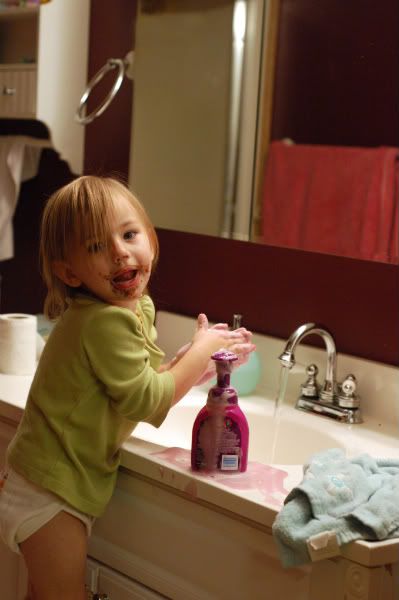
She had a hard time moving on from the "bubble gloves" part. She did a really good job with soaping up though.

There is some debate, I gather, in the Montessori community on whether or not to correct this kind of blatant disregard for the steps of the activity. Some say you should present the materials and then let the child do as they may, as long as they are respectful, and eventually they will begin to copy your demonstration. Some say you should help them through the activity from beginning to end and encourage them to do it the right way.
I obviously follow the former philosophy.
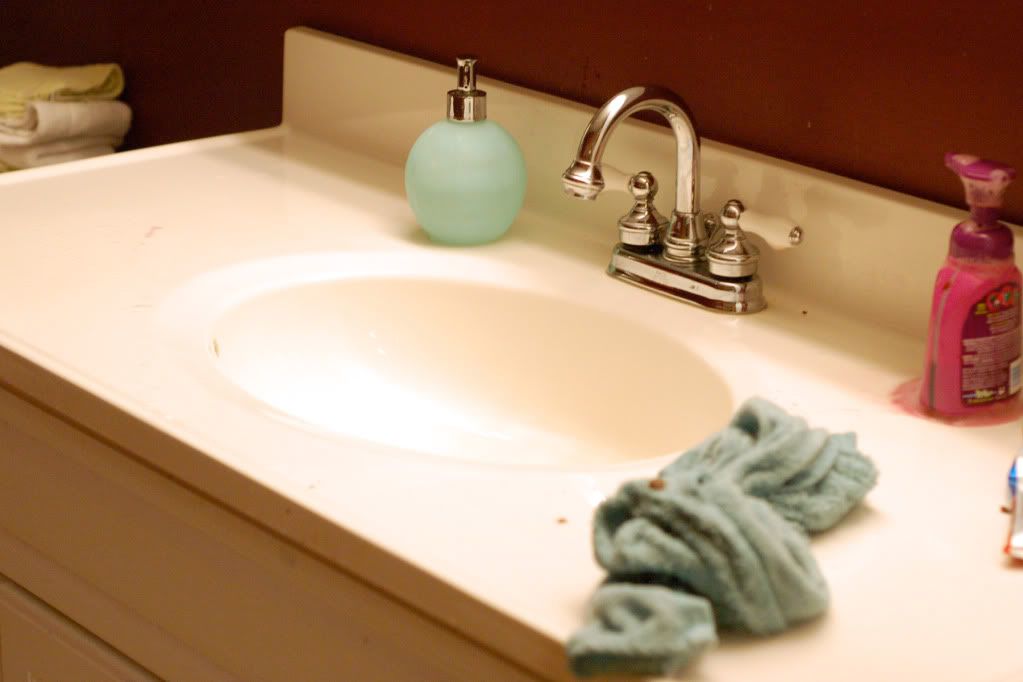
One nice thing did come out of this exercise, as she cleaned up her mess almost entirely by herself.
Tuesday, December 15, 2009
First activity for toddlers - hand washing
My plan is to start simple and with a small amount of setup. We are going to "learn" hand washing today. The thing I am most concerned about is getting my daughter to pay attention to the instructions and proceed in a calm manner. Hand washing is something she does all the time, but she generally uses far too much soap and makes a huge mess with the water so learning the proper way to wash her hands might be fun.
I've never been quite clear on exactly how to explain an activity to the child. I know you are supposed to show rather than explain verbally (which I will talk more about in future posts) but I wasn't sure on the specifics. I found this set of videos on YouTube that seem to be done exactly the way it would be explained to the child. I found this really helpful.
Subscribe to:
Posts (Atom)